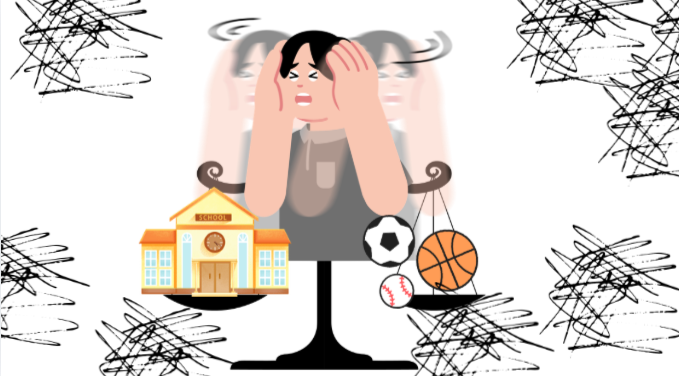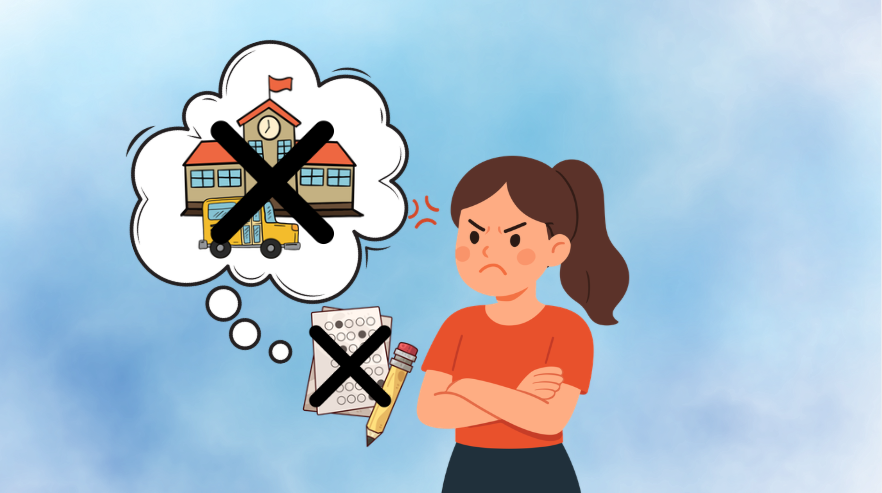
Many students dread the thought of going to school, and sometimes the reason for it isn’t just teenage angst. Although, the reason is not necessarily always the schools, but rather the entire system as a whole due to a lack of freedoms, lack of time, and a handful more.
One of the major things that influences kids to dread school is the current system of choosing classes. To an extent, the classes that students must take are reasonable. In elementary and middle school, understanding the basics of subjects such as science, how the world works, English, and how to speak and write effectively are all understandable and important for kids to learn. In kindergarten through eighth grade, the classes make sense and have purpose, yet when high school begins, that’s when things start to become messy.
As classes begin to reach a certain level of advanced in high school, they begin to lose importance to most. Certain higher level math and science classes are not going to remain relevant to most students as they grow older.
Rather than being forced to take certain classes, students should have a choice. In high school, students begin to grasp what they desire to do when they’re older, and should be able to pursue classes that will truly assist them in the future. Instead of every student being forced to take irrelevant classes, everyone should have a choice, and those who want to pursue things like math in the future can take the corresponding class.
Sophomore student, Jamisen Sinboualay, expresses that students “should have more freedom to explore what we want to learn about.”
Another main factor that makes students dread school is a lack of time. Sophomore student, Jacob Linton, explained it as “with the combination of in-school hours and homework, students in school work the same amount or more than adults who work typical 9-5 jobs.” On top of that, many students participate in extracurriculars and have jobs of their own.
“My brother typically goes to bed at 12-1 a.m. because he has homework to do after he gets off of work,” explained Linton. Some studies have shown that around 80% of high school students don’t get the recommended amount of sleep.
When students have to go to bed at late hours, they aren’t getting a healthy amount of sleep. “Teenagers need eight to ten hours of sleep but can barely get six because of homework,” Linton explained.
One of the main things students dread throughout the school year are standardized tests. Standardized testing is something that may sound good as a concept, a benchmark to see how much students have learned or progressed. However, that is not the reality.
These tests often assess students’ math and english capabilities, and determine students’ futures. If a student does not do well, they can be brought down a few classes and potentially not be accepted into colleges. The system of standardized testing is rather close minded and assesses students inaccurately.
“These tests don’t accurately assess a student’s capabilities, by ignoring creativity, emotional intelligence, and at times ignore proper critical thinking skills by emphasizing memorization over deep thought,” says sophomore, Jacob Cruz.
Unfairness isn’t the only thing that standardized tests bring, but unnecessary stress as well. They negatively affect students’ mental health and sleep schedules; all for a test that doesn’t accurately represent students capabilities.
On top of that, many tests cost money to take, or if a student does poorly the first time you can pay to take them again. However, this negatively impacts those who don’t come from wealthy households, and favors those who are more fortunate. A team of Harvard economists found that children from families in the top one percent of wealth are roughly 13 times more likely to score a 1300 or higher on the SAT/ACT than children from low income families. Cruz stated, “The systems in place oftentimes are unfair and cause for unequal or poor treatment of students.”